Retour
Deuxième partie d'une série en quatre parties consacrée à l'histoire du soutien à la recherche de la FRMD
Pourquoi la FRMD finance-t-elle la recherche fondamentale?
Comment l'étude des cibles thérapeutiques a permis de mettre au point des traitements plus efficaces contre la dystonie
La création de la Fondation de recherche médicale sur la dystonie, en 1976, a coïncidé avec une période où l'étude des troubles du mouvement passait d'un domaine encore vaguement défini à une sous-spécialité neurologique reconnue. À l'époque comme aujourd'hui, la FRMD Canada finançait la recherche fondamentale portant sur des cibles thérapeutiques, c'est-à-dire des molécules présentes dans l'organisme – généralement des protéines ou des acides nucléiques – qui jouent un rôle essentiel dans le processus pathologique et dont la fonction peut être modifiée par un médicament afin de la corriger ou de l'interrompre.
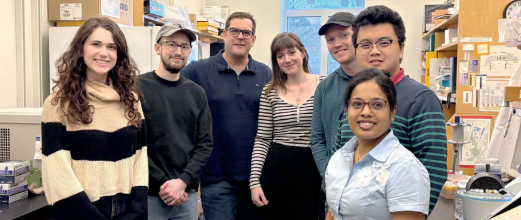
Christian Schlieker, Ph. D. (troisième à partir de la gauche), à la Faculté de médecine de Yale, en compagnie de son équipe de chercheurs du laboratoire Schlieker Le Dr Schlieker travaille à un projet de recherche financé par la FRMD visant à identifier les réseaux génétiques impliqués dans la dystonie DYT-TOR1A. Cette étude portera sur les réseaux de gènes responsables de maladies qui pourraient constituer de nouvelles cibles thérapeutiques.
L'identification de cibles thérapeutiques pour la dystonie a joué un rôle essentiel dans la mise au point de nouveaux médicaments ou l'adaptation de médicaments existants susceptibles d'être efficaces. Ce processus prend du temps, et un financement continu de la recherche fondamentale est essentiel pour éviter que le rythme des découvertes ne ralentisse.
Années 1970–1980 : Essais cliniques et traitements précoces de la dystonie
Hyder A. (Buz) Jinnah, M.D., Ph. D., de la Faculté de médecine de l'Université Emory et membre du Conseil consultatif médical et scientifique (CCMS) de la FRMD, a fait remarquer que les premiers essais cliniques sur les traitements de la dystonie faisaient souvent appel à des médicaments déjà approuvés pour d'autres troubles.
« Les premières tentatives relevaient surtout de l'essai et de l'erreur et ne reposaient pas toujours sur une cible thérapeutique précise », a expliqué le Dr Jinnah. « Comme vous pouvez l'imaginer, il y a eu beaucoup d'essais qui n'ont pas donné de résultats, et ce processus d'essais et d'erreurs s'est avéré très frustrant pour les patients. »
La première région du cerveau associée à la dystonie a été les noyaux gris centraux. Cette découverte a conduit de nombreux chercheurs à envisager de se concentrer sur des médicaments connus pour agir sur la transmission neuronale dans les noyaux gris centraux, comme la dopamine. De nombreux essais cliniques ont été menés sur des médicaments visant soit à inhiber, soit à amplifier la transmission de la dopamine. Ces premiers essais ont révélé qu'un groupe de patients atteints de dystonie réagissait de façon spectaculaire à la lévodopa. On l'appelait la « dystonie sensible à la dopamine » (un terme inventé en 1988, qui désigne un groupe de dystonies héréditaires dont les symptômes s'améliorent considérablement sous traitement à la lévodopa). Des enfants atteints d'une dystonie entraînant un handicap profond ont pu sortir de leur fauteuil roulant et marcher normalement, et les médecins continuent d'utiliser la lévodopa pour traiter cette forme de dystonie. Chez d'autres groupes de patients, les médicaments à base de dopamine semblaient apporter au moins un certain bénéfice, bien que celui-ci ne soit pas aussi spectaculaire que dans le cas de la dystonie sensible à la dopamine.
Le Dr Jinnah a ajouté que l'étude des neurotransmetteurs a eu une grande influence sur l'approche thérapeutique de nombreux troubles neurologiques, dont la dystonie. « L'idée de base était que, si les régions du cerveau utilisaient des neurotransmetteurs pour communiquer entre elles, nous pourrions peut-être modifier cette communication en recourant à des médicaments qui agissent sur cette transmission neuronale », a-t-il expliqué. « C'est ce concept qui a guidé les premiers essais cliniques portant sur les médicaments liés à la dopamine. »
L'acétylcholine était un autre neurotransmetteur des noyaux gris centraux, ce qui a conduit à des essais cliniques portant sur des médicaments anticholinergiques, qui bloquent l'acétylcholine. En 1986, les docteurs Robert E. Burke, Stanley Fahn et C.D. Marsden ont publié dans la revue Neurology les résultats d'un essai clinique démontrant que le traitement par le trihexyphénidyle à forte dose (commercialisé sous le nom d'Artane) est efficace dans la prise en charge de la dystonie de torsion. Même si ces médicaments semblaient efficaces, ils entraînaient de nombreux effets secondaires, ce qui a limité leur popularité. Le Dr Jinnah a souligné que certaines entreprises s'emploient actuellement à mettre au point de nouveaux anticholinergiques présentant moins d'effets secondaires. Les toxines botuliques (BoNT) agissent également sur la transmission des signaux nerveux. Toutefois, au lieu d'agir sur la transmission des signaux dans le cerveau, elles agissent sur celle qui se fait au niveau de la jonction neuromusculaire. « On savait déjà que les toxines botuliques provoquaient une faiblesse musculaire. L'idée était donc que cette capacité à provoquer une faiblesse pourrait être mise à profit dans le traitement de troubles caractérisés par une contraction musculaire excessive », a déclaré le Dr Jinnah. « Elles étaient en fait très diluées et administrées en quantités si infimes qu'elles pouvaient calmer les muscles hyperactifs, comme dans le cas de la dystonie. »
Santé Canada a approuvé le Botox® pour le traitement du blépharospasme en 1990, puis pour celui de la dystonie cervicale en 2000. Il existe désormais au Canada des marques de toxine botulique (BoNT) approuvées pour le traitement de la dystonie, et plusieurs entreprises s'efforcent actuellement de les améliorer en prolongeant la durée de leurs effets.
Années 1990 Le rôle de la génétique dans la recherche ciblée
Dans les années 1990, les découvertes en génétique ont commencé à élargir la compréhension qu'avaient les scientifiques de certains types de dystonie. Par exemple, la dystonie sensible à la dopamine avait déjà été décrite et définie sur le plan clinique par le Dr Masaya Segawa, M.D., Ph. D., au milieu des années 1970, mais ce n'est qu'en 1994 qu'une équipe de recherche dirigée par Hiroshi Ichinose, Ph. D., a identifié des mutations dans le gène DYT5 (plus précisément le gène GCH1) associées à cette forme de dystonie.
Selon Christian Schlieker, Ph. D., de la Faculté de médecine de Yale, dont les travaux de recherche sont actuellement financés par la FRMD, l'identification du gène DYT1 par Xandra Breakefield, Ph. D., et Laurie Ozelius, Ph. D., à la fin des années 1990 a constitué une percée majeure dans l'ère moderne de la recherche sur la dystonie axée sur des cibles.
« La DYT1 est une forme courante de dystonie héréditaire, et sa découverte a constitué une véritable avancée majeure dans ce domaine », a expliqué le Dr Schlieker. « Désormais, un allèle pathogène clairement identifié pourrait être associé à une affection qui était auparavant reconnue sur le plan clinique, mais mal définie sur le plan biologique. Cette découverte a radicalement réorienté la recherche sur la dystonie, la faisant passer d'une approche fondée sur la description des symptômes à un cadre mécaniste et moléculaire. »
Le Dr Schlieker a ajouté que la découverte de la mutation du gène DYT1 avait stimulé les efforts de nombreux chercheurs, notamment ceux financés par la FRMD, pour cerner l'anomalie sous-jacente au niveau protéique. Ces études ont révélé que la torsine A, qui est une protéine essentielle au développement des neurones, est une ATPase AAA+ très atypique (appartenant à une vaste superfamille de protéines motrices) et que la mutation responsable de la maladie perturbe son mécanisme d'activation.
« Cette découverte a permis de redéfinir la dystonie comme un trouble affectant des voies moléculaires spécifiques, mettant ainsi en évidence des cibles concrètes pour une intervention thérapeutique », a déclaré le Dr Schlieker.
Forts du succès du projet DYT1, les progrès réalisés dans les technologies de séquençage ont permis d'élargir rapidement le répertoire des gènes associés à la dystonie. Ce cadre génétique a radicalement transformé la façon dont les scientifiques appréhendent les cibles thérapeutiques : on est passé d'essayer de moduler globalement les circuits neuronaux à identifier des protéines, des voies de signalisation et des réseaux fonctionnels liés à la maladie. Dans l'ensemble, ces connaissances génétiques de plus en plus approfondies constituent une base permettant de comprendre l'étiologie des maladies à l'échelle des systèmes et d'élaborer des stratégies thérapeutiques ciblées, fondées sur les mécanismes sous-jacents.
Ces découvertes génétiques ont ouvert une nouvelle perspective sur les cibles thérapeutiques. Au lieu de se concentrer sur les mécanismes de signalisation dans les régions cérébrales soupçonnées d'être à l'origine de la dystonie, il est désormais possible de se concentrer sur les mécanismes liés aux gènes de la dystonie. Avec plus de 200 gènes désormais associés à la dystonie, cela représente des centaines de nouvelles cibles mécanistes.
« On s'efforce de plus en plus de regrouper ces mécanismes au sein de voies communes », a déclaré le Dr Jinnah. « En ciblant des voies communes, nous ciblons un groupe de dystonies, plutôt que de les traiter une à la fois. »
Une recherche qui s'appuie sur des découvertes antérieures
L'identification du gène associé à une maladie génétique constitue la toute première étape vers la compréhension de son mécanisme d'action. C'est pourquoi la recherche fondamentale s'attache à étudier les voies métaboliques et les fonctions dans lesquelles ce gène est impliqué.
« À mon avis, nous ne comprenons toujours pas comment la torsine A fonctionne réellement. Il n'existe donc pas encore de médicament ciblé », a déclaré Thomas Schwartz, Ph. D., du Massachusetts Institute of Technology, qui a élucidé la structure de la torsine A, ce qui a constitué un grand pas en avant dans la mise au point de médicaments contre la dystonie. « Toute recherche fondamentale nécessite un financement à long terme. La biologie de la torsine demeure le domaine qui promet, à terme, d'ouvrir la voie à un traitement spécifique contre la dystonie. Il s'est avéré difficile de cerner sa fonction, pour diverses raisons, mais le manque général de financement joue un rôle important. »
Le Dr Jinnah a fait remarquer que la recherche actuelle s'appuie souvent sur des découvertes antérieures. « Des efforts sont actuellement déployés pour mettre au point de meilleures toxines botuliques, de meilleurs anticholinergiques et de meilleurs médicaments liés à la dopamine », a-t-il déclaré. « Les muscles eux-mêmes sont désormais une nouvelle cible. Une société a commencé à tester un médicament qui inhibe la contraction musculaire pour traiter les troubles liés à une hyperactivité musculaire, notamment la dystonie. Le principe général est similaire à celui des toxines botuliques, mais le mécanisme d'action est totalement différent : au lieu de cibler la jonction neuromusculaire, ce nouveau médicament agit directement sur le mécanisme de contraction musculaire. »
Les scientifiques s'appuient souvent sur les découvertes faites dans le cadre d'une maladie pour en traiter une autre. Par exemple, environ 30 % des personnes atteintes de la maladie de Parkinson (MP) souffrent également de dystonie. Parfois, c'est la dystonie qui se manifeste en premier, et parfois, c'est la maladie de Parkinson qui fait l'objet du diagnostic initial. Il peut être utile d'essayer les médicaments susceptibles de soulager la dystonie associée à la maladie de Parkinson chez des personnes atteintes de dystonie qui ne souffrent pas de cette maladie. L'épilepsie est un autre trouble qui a donné lieu à de nouveaux essais cliniques dans le domaine de la dystonie.
« L'épilepsie est un trouble de l'excitabilité neuronale, et l'excitabilité neuronale dans la dystonie suscite beaucoup d'intérêt », a déclaré le Dr Jinnah. « Ce mécanisme physiologique a conduit à la mise au point de médicaments visant à réduire l'excitabilité neuronale dans la dystonie, tels que ceux qui inhibent la transmission du glutamate, l'un des principaux neurotransmetteurs excitateurs du cerveau. »
Les années 2000 et au-delà : Domaines de recherche émergents
Le Dr Schlieker a souligné qu'une piste particulièrement prometteuse dans le domaine de la recherche sur la dystonie est la découverte d'anomalies dans l'assemblage et le fonctionnement des pores nucléaires.
« Ces anomalies résultent soit d'un dysfonctionnement de la protéine torsine, comme dans le cas de la dystonie DYT1, soit de mutations touchant des composants essentiels du complexe des pores nucléaires lui-même », a déclaré le Dr Schlieker. « Il est important de souligner que ce lien a été établi grâce à des études indépendantes menées sur des modèles de dystonie totalement différents et à des travaux de séquençage chez des patients, notamment ceux de Michael Zech (qui est également membre du CCMS de la FRMD) et de ses collègues. La convergence des données probantes provenant de plusieurs laboratoires travaillant de manière indépendante a mis en évidence la solidité de cette découverte et a révélé que la biologie des pores nucléaires constituait une nouvelle catégorie prometteuse de cibles thérapeutiques. »
L'équipe de recherche du Dr Schlieker étudie les pores nucléaires, ces canaux protéiques vastes et complexes qui traversent l'enveloppe nucléaire de la cellule et constituent des passerelles essentielles pour réguler le trafic de molécules telles que l'ARN et les protéines entre le noyau et le cytoplasme, garantissant ainsi le bon fonctionnement de la cellule et la régulation génétique. Les chercheurs ont découvert que les pores nucléaires mal assemblés nuisent à l'homéostasie protéique neuronale, qui est nécessaire au maintien d'un bon fonctionnement neuronal et qui régule le transport des protéines vers des sites spécifiques tels que les synapses, où elles jouent un rôle essentiel dans l'apprentissage et la mémoire.
« Cette découverte inattendue a conduit à la mise au point de biomarqueurs permettant de détecter et de quantifier ces anomalies », a-t-il expliqué. « Ces outils sont désormais utilisés par notre laboratoire et d'autres pour soutenir les efforts de découverte de médicaments et pour caractériser systématiquement les anomalies cellulaires liées à la dystonie dans divers modèles expérimentaux. Le parcours menant de la découverte initiale d'un gène à la compréhension de son mécanisme d'action et à la mise au point de biomarqueurs a largement dépendu d'un financement à long terme et soutenu, ce qui montre à quel point un tel investissement est essentiel pour transformer les découvertes fondamentales en stratégies thérapeutiques concrètes. »
L'importance du financement à long terme de la recherche
Le Dr Schwartz a constaté que les fondations peuvent avoir un impact maximal lorsqu'elles financent des projets à haut risque et des idées novatrices. Aux États-Unis, par exemple, « les organismes fédéraux sont connus pour leur aversion au risque et ont tendance à financer la poursuite des programmes déjà en place », a-t-il déclaré. « Le financement de la FRMD a aidé les chercheurs à “mettre un pied dans la porte”, puis à utiliser les données obtenues grâce à ces fonds pour, espérons-le, remporter des subventions fédérales. » Cela a notamment inclus un financement accordé par le ministère de la Défense dans le cadre de ses programmes de recherche médicale dirigés par le Congrès, et plus précisément du programme de recherche médicale évalué par des pairs.
Le Dr Jinnah a souligné que la plupart des subventions accordées par des organismes gouvernementaux comme les National Institutes of Health (NIH) sont assorties d'une durée limitée, généralement de trois à cinq ans. Même s'il est parfois possible d'obtenir le renouvellement de ces subventions pour une deuxième, voire une troisième période afin de prolonger leur durée, les évaluateurs s'intéressent souvent davantage à des projets novateurs, ce qui rend difficile la réalisation d'études qui s'étendent sur une longue période. La FRMD fait office de centre administratif de la Dystonia Coalition (DC), qui regroupe des chercheurs en médecine et des groupes de défense des droits des patients. Depuis sa création en 2009, la Dystonia Coalition a mobilisé plus de 40 centres cliniques en Amérique du Nord, en Australie, en Europe et en Asie, et a réussi à obtenir un financement à long terme pour la recherche sur la dystonie afin de faire progresser ce domaine d'étude. « On peut citer, par exemple, les études d'histoire naturelle qui suivent l'évolution d'un trouble au fil du temps », a déclaré le Dr Jinnah. « Ce genre d'études peut prendre de nombreuses années avant de permettre de dresser un tableau complet d'un trouble, surtout lorsqu'il apparaît dès l'enfance et évolue sur plusieurs décennies. » La Dystonia Coalition a bénéficié d'un financement des NIH pendant près de 15 ans, ce qui a permis de mener une série d'études sur l'histoire naturelle de tous les types de dystonie les plus courants, tels que la dystonie cervicale, le blépharospasme et la dystonie laryngée. Nous avons désormais une bien meilleure idée de ce que nous pouvons dire aux patients concernant le risque d'aggravation de ces affections au fil du temps.
« La FRMD joue un rôle essentiel à bien des égards pour faire avancer la recherche sur la dystonie », a expliqué le Dr Jinnah. « Cela comprend le soutien à des groupes de réflexion spécialisés dans la dystonie, qui abordent des sujets importants dans ce domaine, en réunissant des personnes afin qu'elles échangent des idées, discutent des dernières avancées et parlent ouvertement de ce qui compte vraiment. La FRMD joue également parfois un rôle important en prenant le risque de soutenir certaines idées très novatrices et originales, qui font souvent l'objet de critiques injustes de la part de ceux qui privilégient des modes de pensée plus traditionnels. Enfin, la FRMD joue un rôle clé dans la découverte et le soutien de jeunes chercheurs capables de faire avancer la recherche vers l'avenir. »
Pour le Dr Schlieker, comme pour de nombreux chercheurs dans ce domaine, la FRMD a joué un rôle déterminant pour maintenir l'élan de la recherche sur la dystonie.
« Étant donné que la dystonie est une affection relativement rare, pour laquelle la communauté de recherche est moins importante que pour bon nombre de grandes maladies neurodégénératives, la production des données préliminaires approfondies nécessaires pour obtenir des subventions publiques importantes nécessite souvent un soutien supplémentaire dès les premières étapes, et la FRMD a toujours comblé cette lacune importante », a-t-il déclaré.
« Pour mon laboratoire et mes stagiaires, le financement de la FRMD a à maintes reprises constitué un soutien initial essentiel, nous permettant de mettre à l'essai des idées à haut risque mais à fort potentiel, de générer des données de validation de principe et d'affiner des stratégies expérimentales qui ont ensuite permis de décrocher des subventions plus importantes, d'une durée de plusieurs années, accordées par les NIH et le ministère de la Défense. Ainsi, le financement de la FRMD accélère directement le rythme des découvertes en permettant à des projets prometteurs d'avancer plutôt que de s'enliser dès les premières étapes.
« À l'heure actuelle, nos travaux visent principalement à identifier de nouvelles cibles thérapeutiques grâce à des méthodes de criblage génétique et à faire progresser les efforts de découverte de médicaments à un stade précoce. Aucune de ces deux orientations de recherche n'aurait été possible sans le soutien initial de la FRMD. De manière plus générale, en investissant de façon stratégique dans la recherche précoce fondée sur des hypothèses, la FRMD permet au domaine de passer plus rapidement des découvertes génétiques à des cibles thérapeutiques exploitables, ce qui, en fin de compte, raccourcit le délai entre la découverte et la mise au point de traitements potentiels pour les patients. »
Merci à la FRMD de nous avoir autorisés à adapter et à reproduire ce texte à l'intention de notre public canadien. La FRMD Canada partage la même mission et travaille en partenariat avec la DMRF aux États-Unis afin de financer les recherches les plus pertinentes et les plus prometteuses sur la dystonie à l'échelle mondiale, y compris au Canada.
Source : DMRF Dystonia Dialogue, été 2025, vol. 49, No 1