DMRF Canada is proud to support scientific meetings and educational programs that foster collaboration, spark new ideas, and advance our understanding of dystonia. These gatherings provide vital opportunities for clinicians, researchers, and trainees to share knowledge and identify new avenues toward better treatments, improved diagnoses, and ultimately, a cure.
Meetings, Workshops, and Conferences
- 2026
34th Annual Canadian National Residents’ Course on Movement Disorders
January 30 - February 1, 2026 | Calgary, AB and Virtual
Running since 1992, the CMDS Residents Course has become an “institution” for neurology trainees, with virtually every neurology resident in Canada attending during their training. The course provides an intensive educational experience for residents across the country to improve their knowledge and skills in movement disorders and attract them to the field, including clinical care and research in dystonia.
The program includes dedicated presentations on dystonia. DMRF Canada is proud to continue supporting this important educational initiative and its role in strengthening knowledge of movement disorders, especially dystonia, among neurology trainees across Canada.
2026 Canadian Movement Disorders Society (CMDS) Congress
December 4 - 5, 2026 | Toronto, ON, Canada
This national meeting brings clinicians, scientists, allied health professionals, and trainees together to engage with the latest clinical advances and research changing the landscape of movement disorders care and treatment in Canada. Programming will highlight emergent therapies and clinical trials, new technologies, strategies for improving access to care, and much more.
- 2025
Canadian Movement Disorders Society (CMDS) Meeting
DMRF Canada also supported a virtual meeting of the CMDS to discuss movement disorders. The program featured a variety of topics designed to promote learning from other countries and across movement disorders.
Key themes included:
- Clinical Trial Networks for Movement Disorders
- Disease Registries
- Network Models for Access to Deep Brain Stimulation (DBS)
These discussions contribute to a stronger ecosystem for dystonia care and research, ensuring that knowledge and best practices are shared widely across the movement disorders community.
Neuromodulation in Dystonia
The DMRF USA hosted a meeting on “Neuromodulation in Dystonia.” Neuromodulation involves treatments that use mild electrical pulses to alter nerve activity in targeted areas of the brain or nervous system to reduce muscle spasms and contractions.
The meeting was chaired by Noreen Bukhari-Parlakturk, MD, PhD, Assistant Professor of Neurology at Duke University Health in Chapel Hill, NC, and Michael D. Fox, MD, PhD, Director, Center for Brain Circuit Therapeutics, at Brigham and Women's Hospital in Boston, MA. Session topics included:
- Fundamental Insights into Neuromodulation Targets for Dystonia
- Network Level Effects of Brain Stimulation in Dystonia
- Translational Insights from Clinical Trials in Dystonia
We are grateful to Dr. J.F. Nankoo from Toronto, Canada, for participating. Attendees gained valuable insights from experts across multiple disciplines, and we anticipate new collaborations as a direct result of this workshop.
Canadian Hot Topics in Movement Disorders Conference
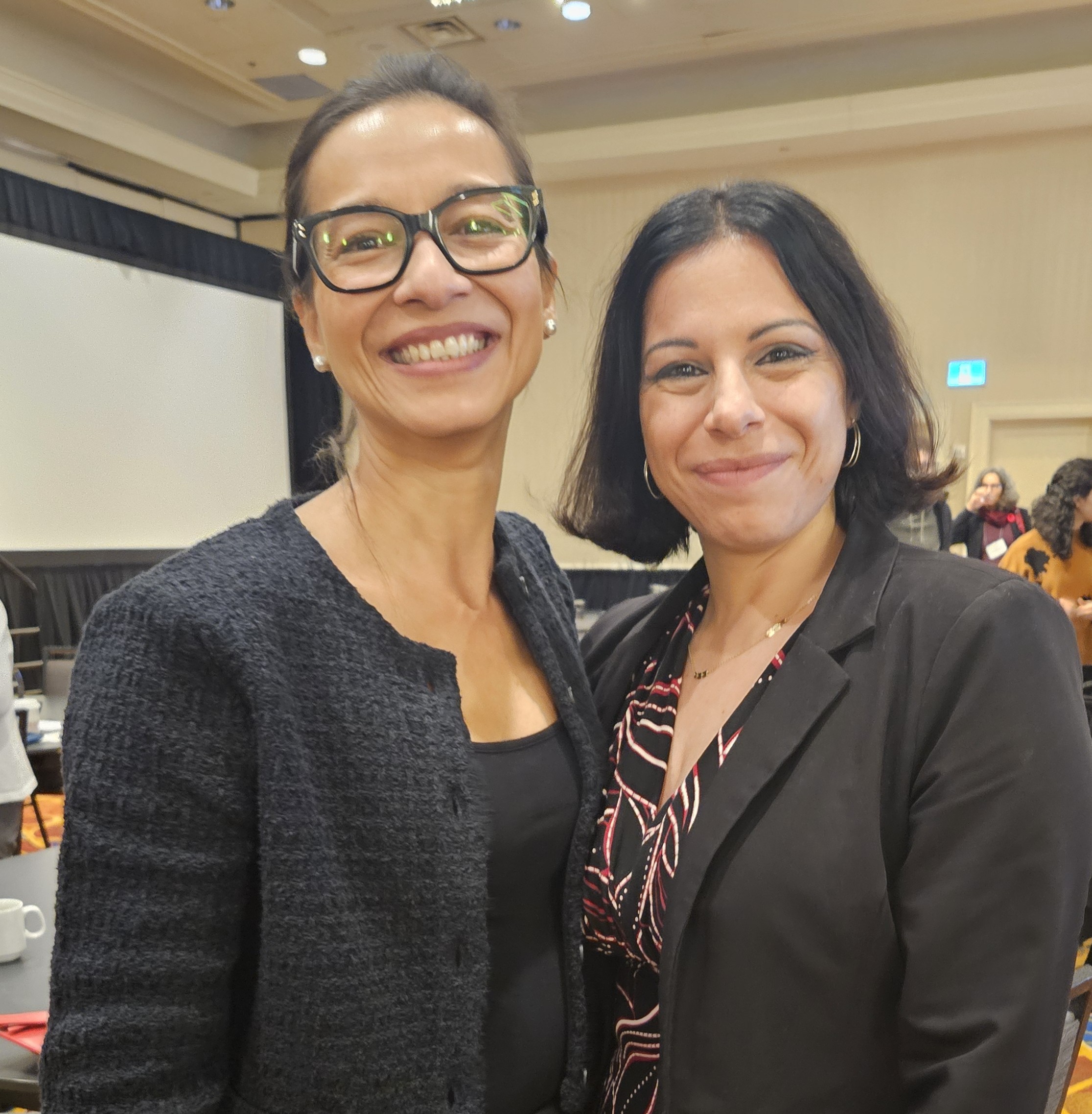
Pediatric specialist Dr. Carolina Gorodetsky, mentor of the 2025–2027 DMRF Canada Clinical and Research Fellow, was among the experts presenting on dystonia. In her talk, she highlighted the complications and challenges associated with diagnosing and treating pediatric dystonia. Her presentation contributed to a conference program that covered a broad and inclusive range of topics across various forms of dystonia.
Featured photo: Dr. Inge Meijer and Dr. Carolina Gorodetsky.
Workshop on Dystonia Penetrance
June 2025 - Helsinki, Finland
Dystonia penetrance refers to the percentage of individuals with a specific genetic mutation who develop dystonia. The DMRF (USA) organized this scientific workshop which was co-chaired by Christine Klein, MD from the University of Lübeck and Christopher Pearson, PhD from the University of Toronto and included leading clinicians and researchers in the field. The goal of the meeting was to deepen scientists’ understanding of the causes and mechanisms of reduced penetrance in dystonia, as well as evaluate existing and identify new research strategies.
The meeting faculty will publish a position paper addressing the most critical aspects of reduced penetrance, aiming to guide future research strategies.
Pan American Movement Disorders Clinical Neurophysiology Course
In May, medical professionals in Toronto hosted this program, led by course director Dr. Robert Chen. Dr. Talyta Grippe and Dr. Karlo Lizarraga, both past recipients of the DMRF Canada Clinical and Research Fellowship Award, were among the speakers sharing their expertise in movement disorders. DMRF Canada supported the participation of future dystonia specialists.
The course, which had a substantial focus on dystonia, participants learned to use neurophysiology studies (tests that show how your brain, nerves, and muscles are working) to guide treatment with Deep Brain Stimulation (DBS) and Botulinum toxin injections.
We are grateful to Ipsen Canada for their generous grant, which supports our efforts to facilitate critical discussions that bring us closer to improved therapies and, one day, a cure.