BACK
Part 3 of a 4-Part Series on the History of DMRF Research Support
The Importance of Clinical Research in Dystonia
The Dystonia Medical Research Foundation was formed at a time when the medical community’s understanding of dystonia was changing. A 2017 article on the history of dystonia published in Movement Disorders Clinical Practice noted that two key researchers in the mid-1970s—both of whom were members of the DMRF Scientific Advisory Board—helped change the way the medical community viewed the condition.
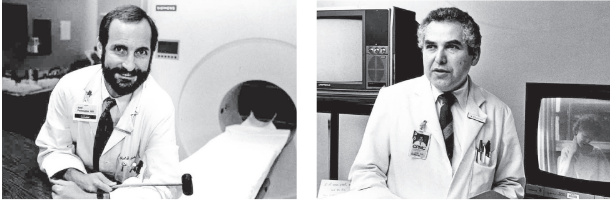
Clinical researchers strive to train the next generation of dystonia experts: (L) Joel Perlmutter, MD and (R) Stanley Fahn, MD
Stanley Fahn, MD, challenged the earlier belief that generalized dystonia was mainly psychiatric in origin and emphasized evidence showing it was caused by physical changes in the nervous system. David Marsden, MD, also played an important role by showing that adult-onset focal dystonias were neurological disorders rather than psychological conditions. Dr. Marsden’s clinical and research work helped establish that these disorders have a clear biological basis.
From the earliest days of the DMRF, funding clinical research for dystonia has been as much a priority as supporting basic research. Basic research investigates the biological and genetic mechanisms of dystonia in laboratories to understand what causes it. This may include experiments with cell cultures, genetic sequencing, and rodent models to study dystonia pathogenesis the biological mechanism and process by which the disease develops and progresses in the body. Clinical research involves using human patients to study the disease’s characteristics, develop diagnostic criteria, and test new pharmaceutical or surgical treatments. This may involve observational studies, patient registries and clinical trials involving patients.
DMRF Scientific Director Joel Perlmutter, MD, noted that the early days of DMRF support for research focused on providing major centers with funding, such as groups headed by David Marsden, MD, Stanley Fahn, MD, and Harold Klawans, MD. Smaller individual grants were not offered initially, but over time the grant process moved to a Medical Scientific Advisory Council that reviewed grants submitted in response to public announcements for grant applications related to dystonia.
Dr. Perlmutter explained that the work of these scientists led to a burst of interest and research funded by the DMRF. “Dr. Fahn’s group pushed the clinical characterization of families, collecting blood for DNA and working with Laurie Ozelius and Xandra Breakefield to eventually find the mutationcausing TOR1A (then known as DYT1) dystonia,” he said. “There were lots of colleagues at those major centers that did much of this work. Mark Hallett did a fellowship with Dr. Marsden, and others in the Marsden group included Peter Jenner, John Rothwell, Michael Sheehy, Niall Quinn and others. Dr. Fahn trained Susan Bressman, Mitchell Brin, Robert Burke, Paul Greene, and many others. Dr. Klawans trained Christopher Goetz who helped train Cynthia Comella and others. So, a major contribution of these centers was the training of these people.”
Making Progress in Dystonia Research
Over the last five decades, clinical research in dystonia has shifted from purely observational descriptions to more targeted interventions. The field has evolved with an overhauled classification system of dystonia, mapping the genetic causes of the disease, and refining precision treatments like botulinum neurotoxin and deep brain stimulation (DBS).
Since dystonia is highly heterogeneous—patients can have very different symptoms, causes, and disease progression— researchers need large, well organized clinical databases and biospecimen collections that combine genetic, clinical, and imaging data. The Dystonia Coalition (DC) was launched in 2009, with the stated mission to advance clinical and translational research in the dystonias to improve researchers’ understanding of its clinical manifestations and pathogenesis, and to find better treatments and a cure.
Originally funded by the National Institutes of Health (NIH), the Dystonia Coalition operates as a global consortium of medical researchers, clinical centers, and patient advocacy groups including the DMRF dedicated to advancing clinical research and finding better treatments for various forms of dystonia. The coalition is focused on cooperative planning, implementation, conduct, and reporting of clinical and translational studies, including clinical trials, and it is interested in educating professionals and the public by providing scientific and medical information about dystonia. The support from the DMRF has played an incredibly key role in the Coalition.
Building a Pipeline of Researchers
The DMRF has demonstrated success in building a bridge between basic neuroscience research with patient-centered clinical studies. “As an MD who works also in fundamental neuroscience, a bridge is an appropriate metaphor for the importance of combining patient-centered research with basic neuroscience because it is bi-directional,” explained DMRF grant recipient Joaquim Alves da Silva, MD, PhD from the Champalimaud Foundation in Lisbon, Portugal. “If we understand the fundamental neuroscience that governs how movement is produced from the more molecular to the more circuit-relevant insights, we can have better models of what may be underlying the development of dystonia… Diseases such as dystonia can also provide unique observations on how the brain works.”
Former DMRF clinical fellow Laura Scorr, MD, from Emory University School of Medicine, credits the DMRF with putting her career on the path to clinical research. “I didn’t enter fellowship knowing I wanted to focus on dystonia or be involved in clinical research, but I am so grateful to have found this path, which has been immensely rewarding,” she said. “My DMRF fellowship was critical in launching my career as an academic movement disorders neurologist focused on clinical research in dystonia to improve patient outcomes.”
Research Takes Time and Funding
For science to move forward, new researchers must continuously be brought into the field and maintain funding for their studies. Scientists who specialize in investigating a rare disorder like dystonia might spend the better part of a decade on training and preliminary research, making the need to maintain momentum vitally important.
“When there are whole areas (of research) that remain unfunded, even if it’s for a year or two, those investigators will either find new careers, maybe in industry, maybe something else, or they find new things to work on,” said Roy Sillitoe, PhD, a former DMRF grant recipient from Baylor College of Medicine and Texas Children’s Hospital. “Because at the end of the day, we’re still scientists, and what drives us internally is curiosity about biology and medicine. So, if we can’t be funded in one (area), we’re going to pursue science, but in something else. And that’s devastating for the field, because there’s already been a ton of investment, money, time, and energy into these investigators. Once that happens, the entire lab shifts, and you lose the next generation. You’ve not only lost the current expertise and knowledge in the room, but you’ve lost the future as well.”
Dr. Sillitoe added that foundations like the DMRF have a greater willingness to fund exploratory studies, whereas federally funded grants tend to be more risk averse. “You don’t get breakthroughs from doing incremental science. You get breakthroughs from either serendipitous findings, or from very risky work. This is where foundations are very valuable, to try things that will not be funded by other mechanisms".
Shared with permission from DMRF Dystonia Dialogue Summer 2026 Vol 49. No 2