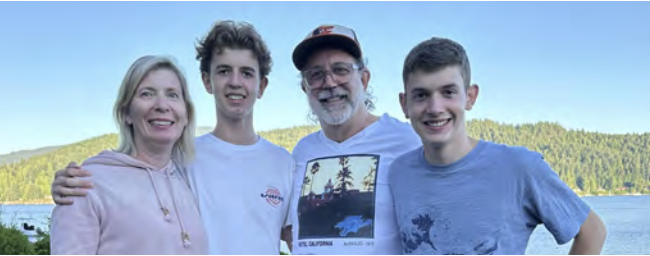
Husband and wife, Lance Howitt and Julie Trant, spent a lot of years not talking about dystonia.
Julie (whose story you may have seen featured in last year’s mailout fundraising campaign), was diagnosed as a child, but found ways to cope with and hide her symptoms. It wasn’t until one of their sons received his diagnosis of dystonia, that out of necessity, they really started talking about it. This is what brought them to DMRF Canada and prompted Lance to prioritize his involvement, spearheading individual fundraising and awareness efforts in coordination with DMRF Canada, and then formally joining the board of directors in January of 2025.
Julie and Lance first connected with DMRF Canada in 2017. Since that time, both Julie and her son have undergone successful treatment with Deep Brain Stimulation (DBS) in France, under the guidance of internationally recognized movement disorder and dystonia expert Dr. Laura Cif. While they sought treatment overseas, Lance and Julie recognized the value in having knowledge available through a Canadian entity. “Early on, DMRF Canada was very important for us because the resources helped us understand more about dystonia, the available treatment options, and to formulate all the different questions we should ask before having the surgery,” Julie remembers.
After the remarkably transformational results of DBS and realizing the valuable role DMRF Canada played in supporting their family during a difficult time, Julie and Lance set to work partnering with the foundation to bring awareness and raise funds for dystonia research. They have prioritized donating financially, but Lance began to recognize they may have more to contribute. “Money is only one resource. It's really about time, expertise and a network,” Lance says. “In many respects, those resources are a lot more scarce - and therefore valuable - than just the dollars.”
It's those intangibles that Lance brings to his position on the board. As an accomplished serial entrepreneur and early adopter of technology, Lance has found success in business. “My accomplishments are not a result of formal education. It’s just having the strategic vision and internal courage to get out there and get it done.” he explains. “Having focus on gaps and opportunities in industry for many years, I intuitively understand many of the issues people face in their organizations. I'm always trying to connect people with constructive ideas to solve problems and move forward. Finding that nexus is what I've done successfully for 30 years. Through my philanthropic role on the board of DMRF Canada I hope to augment our family’s financial contributions with greater influence and success.”
Lance and Julie hold research as a high priority when it comes to the impact they would like to make in the world of dystonia. The positive impact of research and modern medicine on Julie’s and her son’s quality of life has been immeasurable. When asked what he will look at as a mark of success for his time on the Board of Directors, Lance has his family’s experience in mind. “If we can find any kind of research breakthrough in diagnostics, treatment or prevention that will be very important progress,” he says. His background in big picture thinking and value on connection gives him some innovative ideas as to how this can be done. Commenting specifically about the leverage AI technology has for medical research and the multi-centre project led by Dr. Cif , Lance says, “If we can create more of an interwoven community between the Canadian medical community and expert researchers from around the world, there’s a key role that our people, our contribution and our country of Canada can play.
DMRF Canada has a long history of knowledge sharing with researchers and medical professionals from around the world. They hope that further interconnecting Canadian initiatives with what is happening globally can have an impact at the local level. Lance has observed, “By population Canada is a relatively small country and DMRF Canada, works on a pretty limited budget, which inherently limits opportunity and to some degree awareness as well. Dystonia is not a well-known disorder, so it doesn't attract a ton of attention.” By getting louder about their family’s experiences with dystonia, they are using their voices to raise awareness. Julie has been generous in sharing her lived experience to provide information and hope to others. She has noted how important it is that the broader community helps to “get the word out to more people” to improve the level of understanding about dystonia. This is a role they both embrace. “I'm just trying to see if I can get creative and help spread the message- an awareness message, and a message of hope,” says Lance.
With research and awareness at the top of their list, Lance and Julie are making great contributions towards a future with a cure for dystonia. By leveraging local Canadian infrastructure and the DMRF Canada to connect and integrate even more with the world of global research and innovation, Lance and Julie are providing hope and a necessary push to think big. “A cure can just come from one person, one idea, one innovation, one moment in time, one place in the world. It could happen here in Canada.” Lance says.
At DMRF Canada we share Lance and Julie’s hope for the future. It’s because of commitment from members of our community like them, that we can move forward with our goals.